A running hat has one job that a baseball cap does not: it has to keep working while soaked in sweat, in full sun, at a pace that generates real heat. That single requirement pushes running headwear toward specific fabrics, weights, and construction choices, and it is why a cotton dad cap feels like a wet sponge by mile two while a purpose-built running cap disappears on the head. This guide breaks down what actually separates a good custom running hat from a printed novelty, one material and construction decision at a time.
The fabric does the cooling
Almost every serious running cap is built from polyester or a polyester-elastane blend, and often from recycled polyester specifically. The reason is moisture management. Polyester is hydrophobic, so instead of absorbing sweat and holding it against the skin the way cotton does, it wicks moisture to the surface where it can evaporate. Add a small percentage of elastane and the crown flexes to fit a range of head shapes without a hard band digging in. Some premium caps layer in proprietary treatments for faster evaporation, but the underlying principle is the same across the category: move water out, let air move through.
Ventilation is the other half of the fabric story. Mesh panels along the sides or a laser-perforated crown let heat escape from the top of the head, which is where a surprising amount of it leaves the body. When you specify a custom cap, the mesh is not a cosmetic detail; a solid-crown cap prints beautifully and cooks the wearer, while a well-vented one stays comfortable but gives you a smaller unbroken area for a logo. That trade-off between print real estate and airflow is the first thing to settle.
Weight is a feature, not a footnote
Runners notice grams in a way that casual hat buyers never do. A dedicated running cap can weigh astonishingly little, and independent field tests put the lightest packable models under 20 grams, with typical performance caps landing somewhere in the 25-to-60-gram range depending on brim stiffness and panel construction.
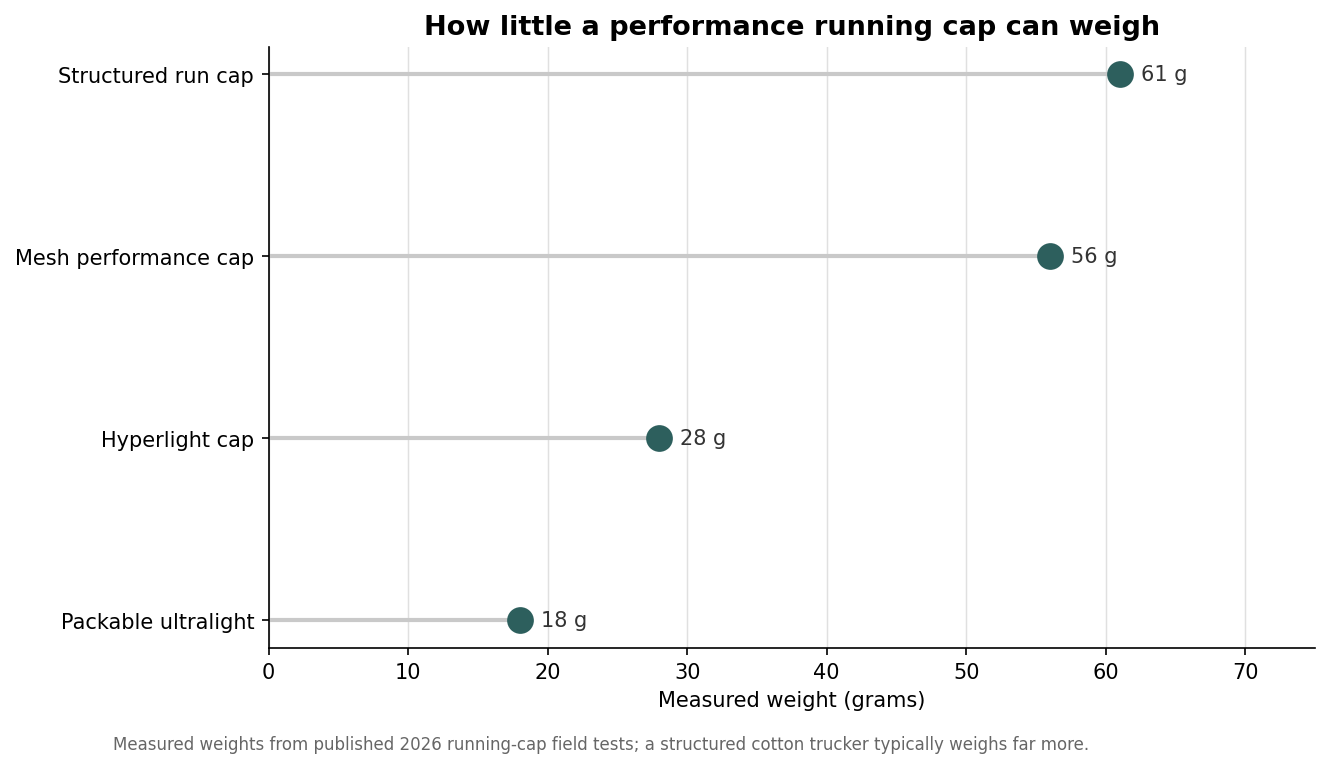
For comparison, a structured cotton-twill trucker of the kind handed out at most events weighs well over double the heaviest cap shown here once you add the buckram front and plastic snap. None of that matters for a giveaway that lives in a drawer, but it matters enormously for a cap meant to be worn on long runs. If your audience is a run club or a race field, weight is a genuine selling point, and an unstructured, low-profile build is what delivers it. If the cap is primarily a branding piece for spectators and volunteers, a heavier structured style is perfectly fine and prints more crisply.
Brim, crown, and how a cap fits at speed
Brim length is a real specification with real consequences. Running caps cluster around a 2.5-inch brim, with sun-focused models reaching past 3 inches and minimalist racing caps trimming down toward 2.4. A longer brim shades more of the face and blocks low-angle sun, but it also catches more wind and bounces more on a fast descent. A shorter brim sits quietly and packs flatter but offers less shade. There is no universally correct answer, only a match to how and where the cap will be worn.
The crown decision is structured versus unstructured. A structured crown holds its shape off the head and gives a stiff, flat front panel that shows embroidery and printing at their best. An unstructured crown collapses soft against the head, breathes better, and can be stuffed into a pocket, which is exactly what a distance runner wants. Rear closure matters too: an elastic or self-fabric strap keeps the cap secure and low-profile, while a plastic snapback is bulkier and can press uncomfortably during a long effort. For a running-specific order, unstructured crowns with a soft adjustable closure are usually the safer default.
Sun protection, honestly measured
Sun protection is where marketing and reality often diverge, so it helps to read the actual UPF rating rather than the word “protective” on a hangtag. Rated running headwear ranges from around UPF 25 on the lightest caps to UPF 50+ on sun-focused designs, and the number reflects how much UV the fabric blocks.
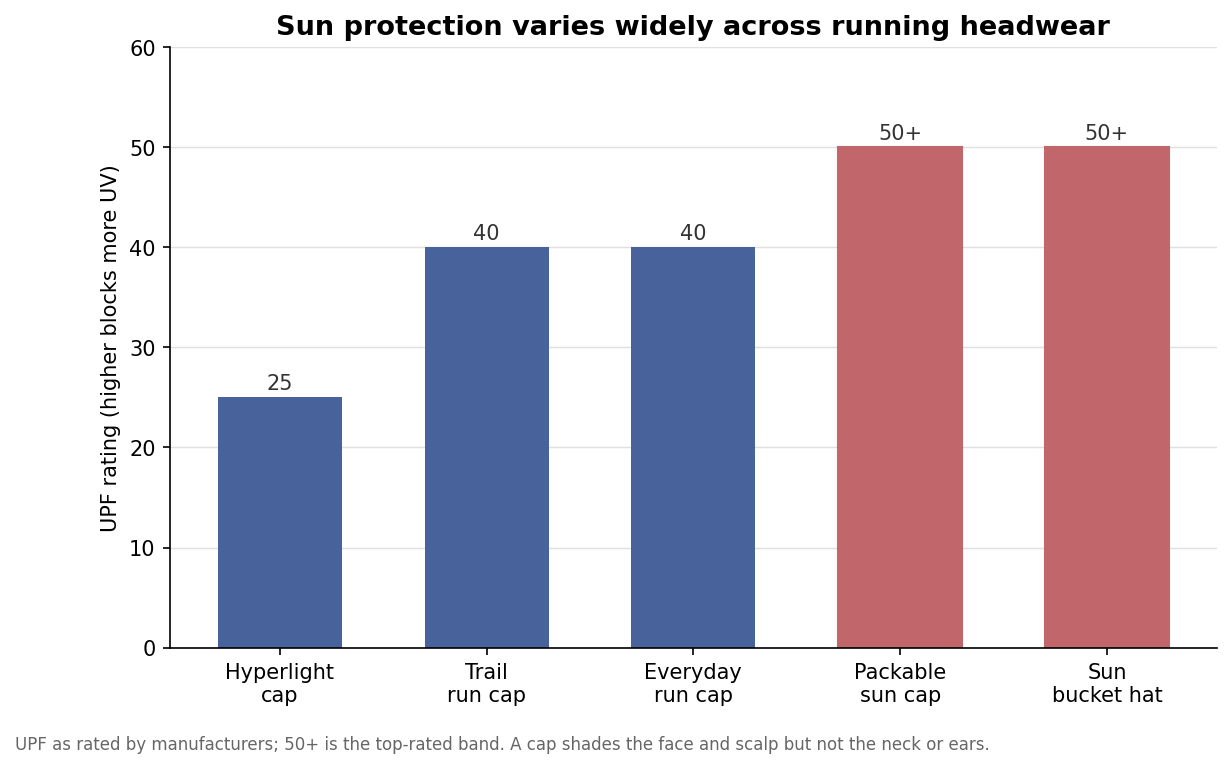
Two caveats keep this honest. First, a cap protects the face and scalp but does nothing for the ears and the back of the neck, which is why long-brim and bucket styles exist for high-exposure conditions. Second, UPF describes the fabric, not the coverage, so a high rating on a tiny racing cap still leaves plenty of skin exposed. If sun is the priority for your buyers, specify both a genuine UPF rating and a coverage style that matches the environment rather than assuming a logo cap does the job.
Choosing a blank worth printing on
Once the performance requirements are set, the last decision is which blank platform to build on, and the market offers clear archetypes. Structured six-panel caps such as the Richardson 112 give you a firm front for a bold logo and a trucker-mesh back for airflow, a strong all-purpose choice. Five-panel and low-profile OTTO styles sit closer to the head for a cleaner running silhouette. Performance sport caps in lightweight polyester lean fully into the wicking-and-venting priorities above. The point of naming these is not that one is best, but that the blank determines your decoration method: firm structured panels take embroidery and heat transfer cleanly, while soft technical fabrics are better suited to sublimation or a thin printed application that flexes with the material.
Put the decisions in order and a custom running hat stops being guesswork. Start with a wicking polyester fabric and real ventilation, keep the weight down if the cap will actually be run in, match the brim and crown to the use, insist on a stated UPF where sun matters, and only then pick the blank and the print method. Specify it that way and the hat earns its place on a runner’s head long after the event banner comes down.